A Solar System's Baby Pictures
Over the past four years, scientists using the Very Large Telescope (VLT) down in Chile have been taking photos of a young star, AB Aurigae. But it's not the star they are looking at so much as what's around the star: a swirling disk of gas and dust that will some day (in the far future, by human standards) become a planetary system.
Normally we wouldn't be able to see this system from Earth, because the star's brightness would envelope everything around it. We would only see a star, like people have for hundreds of thousands of years. But the SPHERE instrument at the VLT allows us to block that starlight out of the equation so we can see what's around the star.
So, what are we looking at here? This is a swirling cloud of hot gas and dust, orbiting the star (which is blocked) in the middle by the force of its gravity. The image to the right has been enhanced so you can see what is happening a bit more clearly. You can see from the glow that some areas are dark and shadowy, kind of twisting as they follow the path around the star. These are areas where gas and dust are coalescing as they orbit, becoming opaque as they gather material. Over time, more and more gas and dust will collect in these areas, held together by gravity. The more mass accumulated, the stronger the gravity, and the more material will be drawn in. Eventually, these areas could become planets orbiting the star, forming a system just like our solar system. The image below shows arrows pointing at the shadowy areas that scientists are interested in:
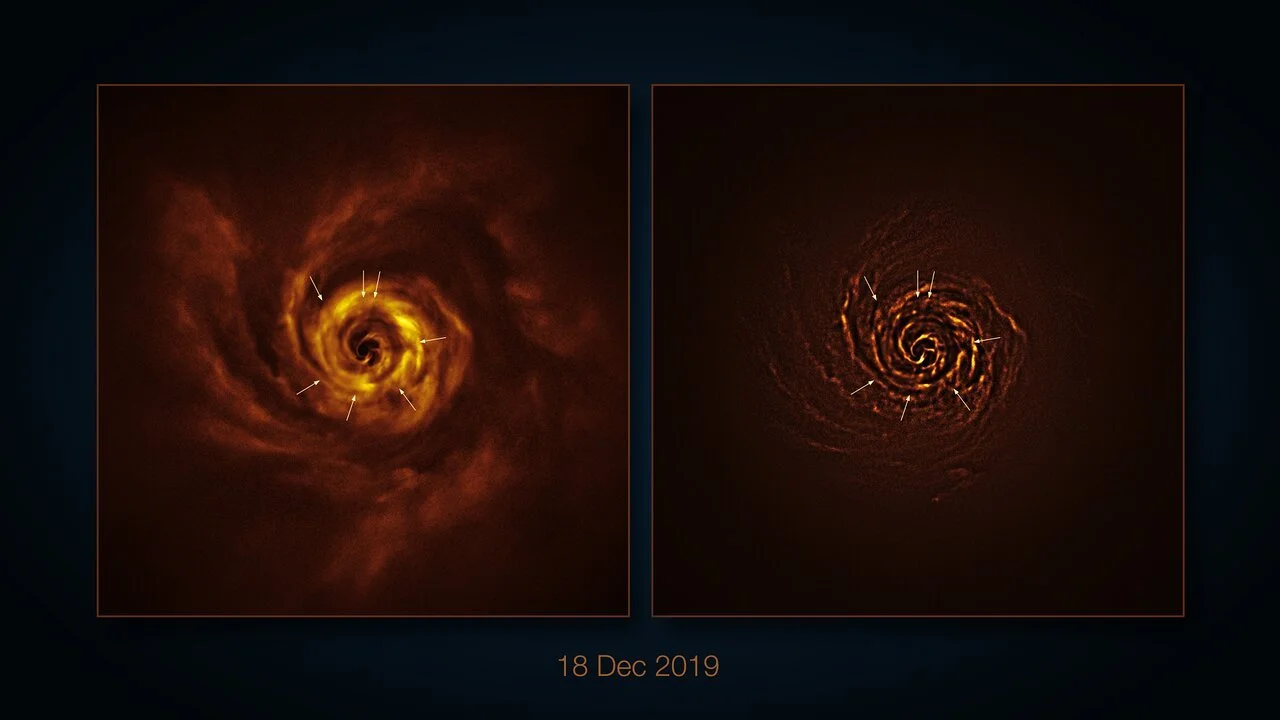
ESO/A. Boccaletti et al.
By watching the AB Aurigae system, scientists can see an example of how planets form. This in turn could help us understand how our own solar system came together billions of years ago.
More about the SPHERE Instrument
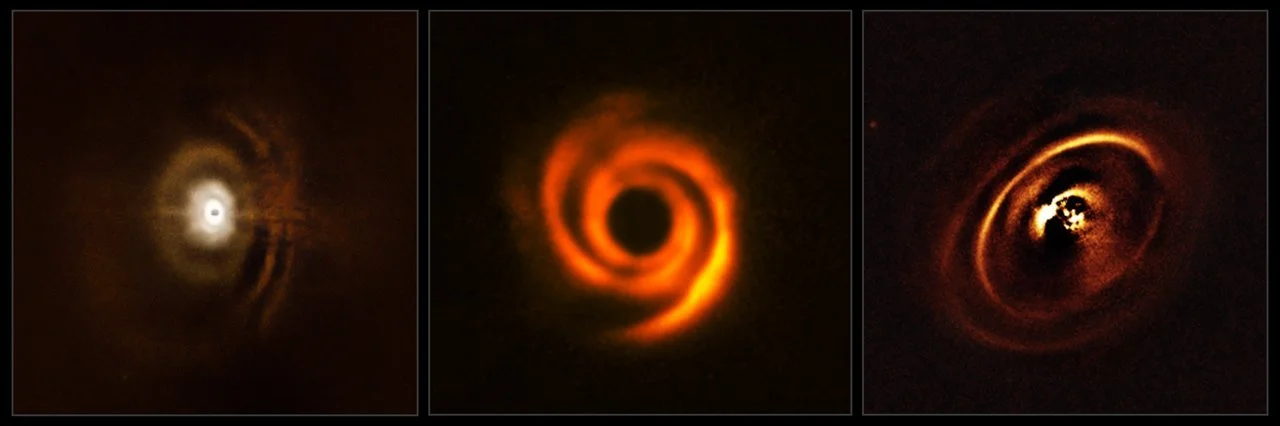
SPHERE stands for Spectro-Polarimetric High-contrast Exoplanet REsearch, and it is just one of the instruments at the European Southern Observatory at Paranal, Chile. This instrument was designed specifically to locate and image exoplanets directly, rather than discovering them using the indirect means that people have used since the 1990s. What it does is block unpolarized light from the star, leaving only the partially polarized light that is filtered by gas and dust, or from light that has reflected off another surface, visible. ESO scientists have used this instrument to study planetary formation as well as other things like the end stages of a star's life cycle. SPHERE has capture other images of proto-planetary discs over its 12 years of operation:
Exoplanet study is one of the fastest growing fields in astronomy right now, and we are learning new things every year. Perhaps some day we will learn exactly how solar systems are formed, and what made life possible on Earth!