T Corona Borealis: Nova or Not?
If you get astronomy news on your feed at all, chances are you've seen the name T Corona Borealis, or the "Blaze Star," come up over the past two years. This star (or more specifically, star system) has not only been getting a lot of news, but has also been the target of a lot of misinformation. I thought I would try to clear a few things up here.
T Corona Borealis is a binary system of two stars connected to each other by gravity, about 800 light years from Earth. One of these stars is a white dwarf, a very old dense star, and the other is a red giant, a much larger star in size than its partner but much less dense. Dense stars like white dwarves have a lot of mass in a very small body. This means their gravitational pull is relatively strong. For T Corona Borealis and other binary systems, it means that the gravity of the white dwarf is strong enough to pull hydrogen from its companion star. This hydrogen builds up in a shell around the star, heating up over time. Year by year, it gets hotter and hotter, until it reaches a critical point where a chain reaction happens, and this outer material gets blasted off the star in a nuclear eruption into space at thousands of miles per hour. This increases the brightness of the star so much that a star that is usually invisible to the naked eye suddenly becomes one of the brightest stars in the sky. Then, after the material is burned off and dispersed, the star become dim again, and the process repeats itself. This is the lifecycle of a nova (not to be confused with a supernova, which is different--I'll explain that later). For T Corona Borealis, this process repeats about every 80 years. This is how we know that it should be happening again right about now.
T Corona Borealis has been observed going nova several times throughout history. We have records going back to 1217, where a German abbott called it a "wonderful sign." Scientists have been observing it carefully over the last century to learn more about it. The last time it went nova was in 1946, and scientists have records of the stages it went through prior to the nova. In 2015, scientists began to see signs that happened about 8 years before the last eruption, so they predicted that in the mid-2020s, we would see T Corona Borealis go nova again.
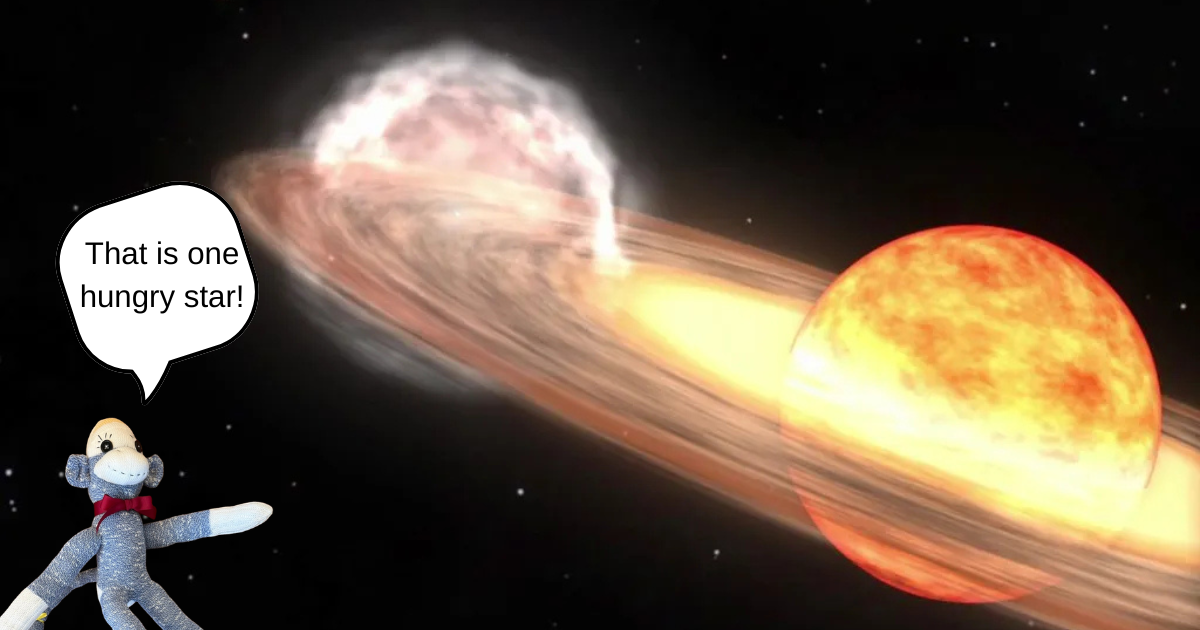
Image: NASA, annotated by Melanie R. Meadors
Since 2024, scientists have been saying that T Corona Borealis is going to erupt any time now. In September 2024, they predicted there was a 70% chance that month, and a 95% chance it would do so by the end of that year. When it didn't, they became more convinced it would definitely do so in 2025. Only...it didn't. This month, news started up again, with people saying it will happen by the end of the month. In truth, we can't really predict it precisely. There are a lot of factors going on, including the strength of the white dwarf, the amount of material in the red giant, and the speed the dwarf accumulates the material. We don't know everything about these processes yet, which is why it's exciting when they do happen. It allows us to learn more.
A nova is different from a supernova. A supernova only happens once to a super massive star, much larger than a white dwarf. It is a huge explosion the results in a neutron star with a nebula around it. It can even result in a black hole if the star was massive enough. Supernovae are more rare than novae. But it marks the death, more or less, of the star, and it doesn't happen again, whereas a nova is periodic and happens in cycles. A nova isn't exactly an explosion, it's more of an eruption of material. A giant stellar burp, if you will. But it's very rare to see a repeated eruption within human lifetimes. Often novae occur in much longer cycles. Plus this system is quite close to us, and will make the night sky look different for a few days. So this is a really cool event.
So, when you see news about T Corona Borealis, remember that it's not going to completely explode, and there is nothing wrong just because our predictions were off. This has happened before with this star, and it will happen again with this star. That doesn't make it less cool or less dramatic.
When T Corona Borealis goes nova, it will go from invisible to be about as bright as Polaris, the north star, which is among the fifty brightest stars in the night sky. It will stay bright for a few days, then will dim once more. So do keep your eyes on the sky in between the constellations Hercules and Bootes--Corona Borealis is a curved line of stars between them.
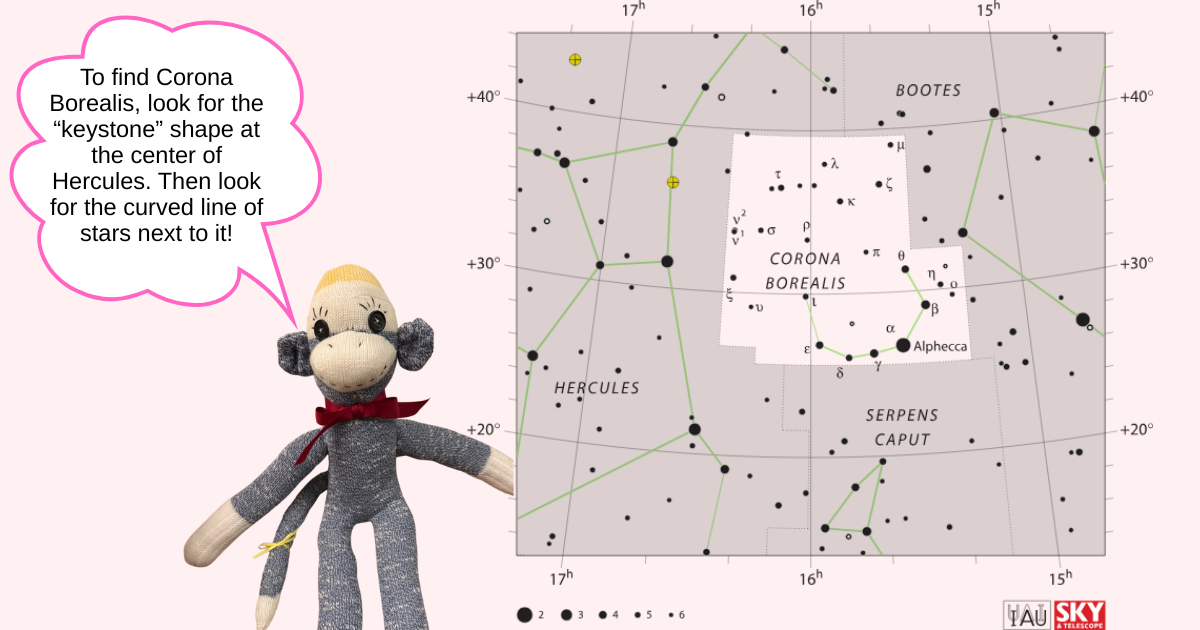
Image: Sky and Telescope, annotated by Melanie R. Meadors
Want to get a printed zine with all kinds of fun facts and information about space delivered to your mailbox every month? Sign up for my Patreon!