The Owl Nebula, M 97
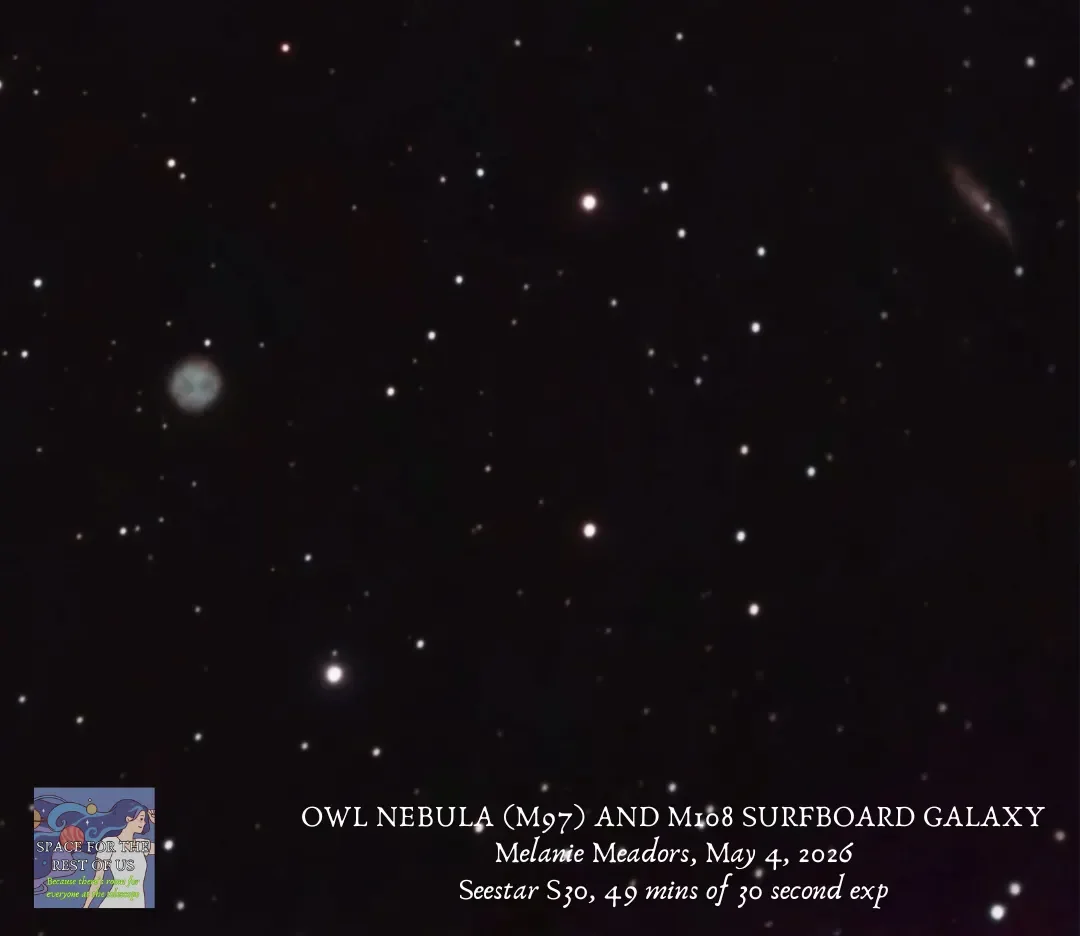
Owl Nebula to right, Surfboard Galaxy to right
Pretty much everyone in the northern hemisphere is familiar with the asterism (group of stars that makes a picture, but that is not an official constellation) known as the Big Dipper in the U.S., the Plough in the U.K., and other names elsewhere in the world. It is part of the constellation Ursa Major, the Big Bear. We see it in the sky every clear night, and most of us learned in school that you can use the two stars at the end of the dipper to point to Polaris, the North Star. It’s easy to take this asterism for granted since we see it so often. But this area of the night sky is full of amazing things to look at through a telescope. One of these things is the Owl Nebula, or M 97.
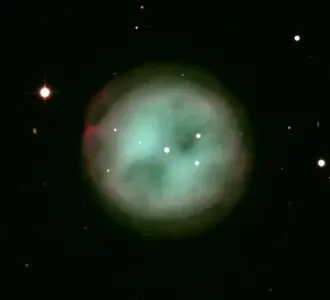
M 97, NOIR Laboratory
Now, I will admit, finding this nebula in the telescope isn’t the easiest thing, It’s one of the faintest objects in the Messier catalog, and it’s pretty small. But it’s really interesting to look at, because…well…it looks like an owl!
If you are enjoying this article, please consider subscribing to Space for the Rest of Us! Free subscribers get a weekly article, and paid subscribers get behind the scenes looks at my research and sneak peeks of my book projects.
You can find the Owl Nebula by looking at the Big Dipper. Go along the bottom of the dipper between the stars Phecda and Merak, about 3/4 of the way across away from the handle. Then go down (relative to the dipper) just a little bit, and there it should be. It’s always above the horizon in the northern hemisphere.
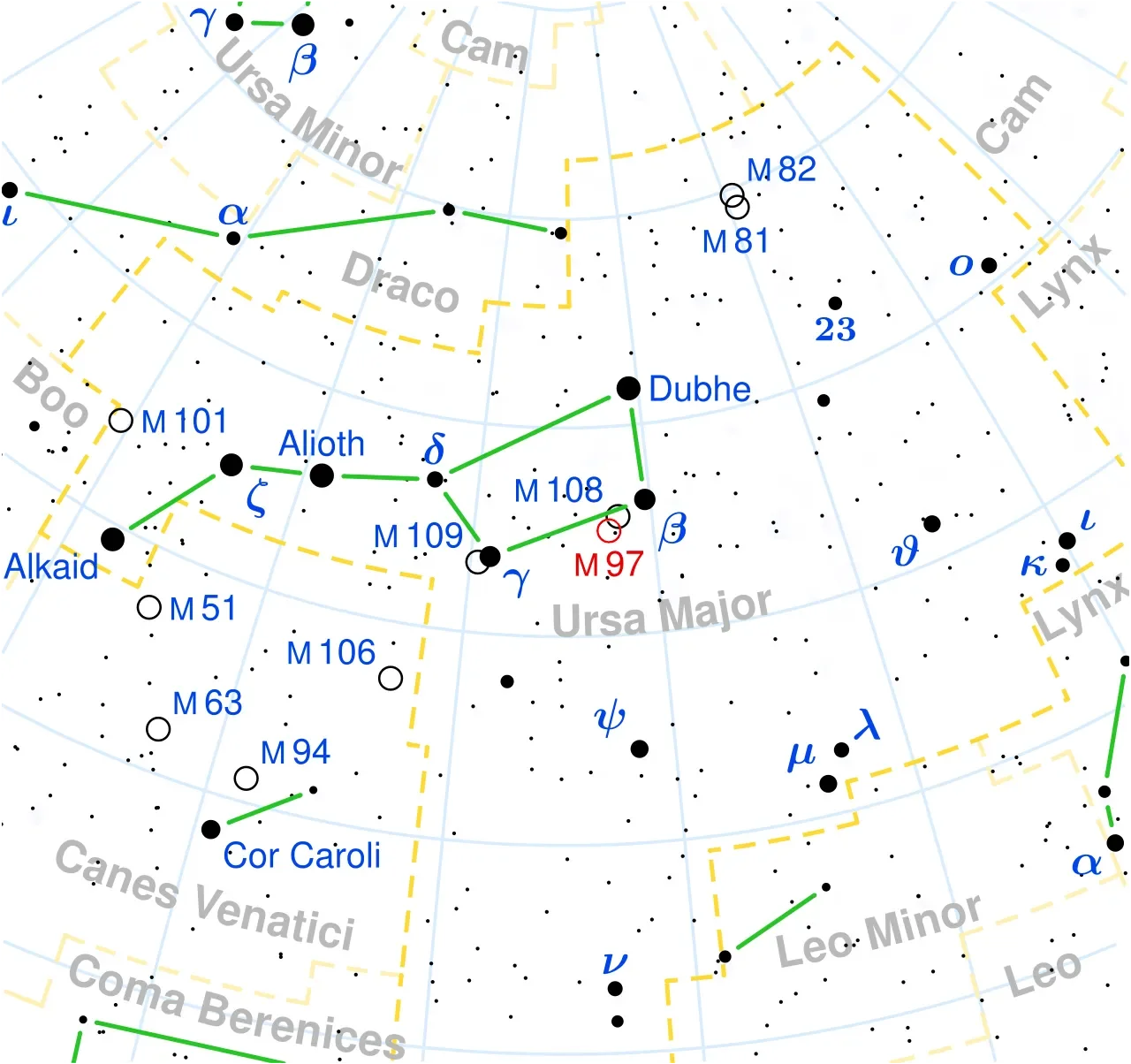
Diagram of where to find the Owl Nebula, M 97, in red.
M 97 is a planetary nebula, which means it’s formed from the remnants of a dying star. The colored material is ionized gas and dust from the star that it released after going from a red giant to a white dwarf.The dim, dense star is still in there. but it has released a lot of its material into the space around it. The star in the Owl Nebula is about half the mass of our sun now, but the nebula around it is almost two light years across and is growing bigger every second as the solar wind from the star blows the material outward at a speed of around 30 kilometers per second. If you stood on one side of the nebula, the light you see from the other side would have taken two years to reach you! Scientists estimate this nebula to be about 8,000 years old.
M 97 was discovered by Pierre Méchain, one of Charles Messier’s observing partners, on February 16, 1781. After Messier himself saw it a few weeks later he added it to his now infamous catalog of celestial objects and gave it the number 97. Years later, William Parsons saw the nebula through his telescope and commented that it looked like an owl’s head with two big eyes. The name stuck, and now we know it as the Owl Nebula.
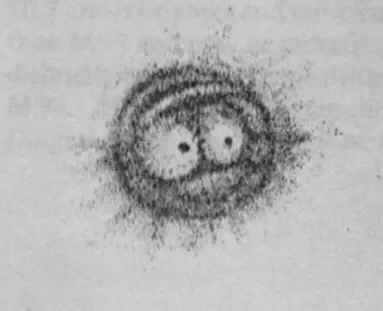
William Parson’s drawing of what he called the Owl Nebula
When Messier wrote abut M 97, he noted that when Méchain found it, he also saw another “nebula” nearby, but never added that object to his catalog. William Herschel, not knowing about Méchain’s observation, also saw this object in 1789, cataloging it in his own system. Once astronomers learned about galaxies thanks to Edwin Hubble’s work in the early 20th century (before that we thought there was only one galaxy—ours!—and all the rest were nebulae within our galaxy), they realized this was not a nebula at all, but another galaxy! It is a barred spiral galaxy like the Milky Way, and is about 46 million light years away. From Earth, we see the galaxy almost edge-on, giving it an oval shape which earned it the nickname the Surfboard Galaxy. It was finally added to the Messier catalog in 1953 with the number 108.
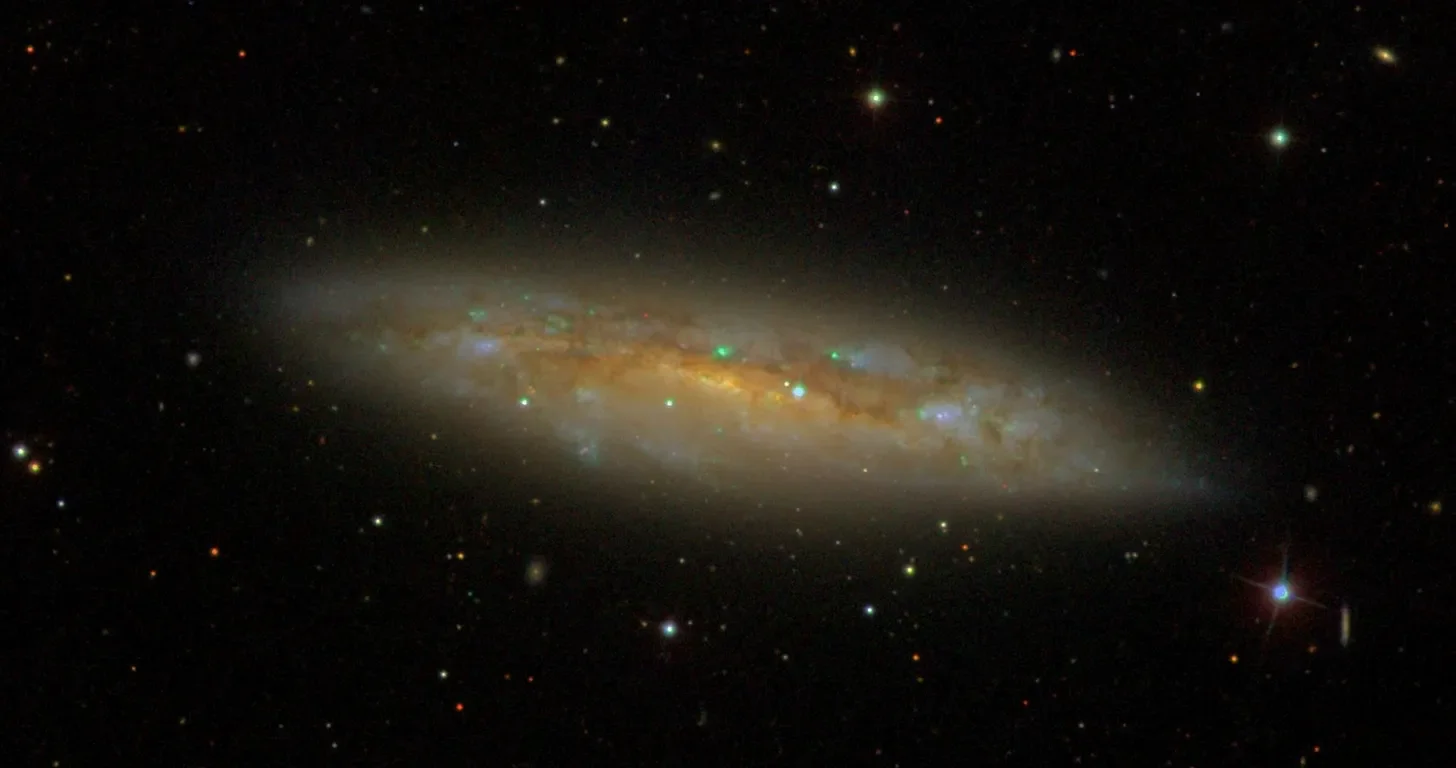
M 108, Sloan Digital Sky Survey
This galaxy has been studied by scientists using the Chandra X-Ray Observatory, which recorded several X-ray sources coming from the galaxy, including one that suggests a moderate-sized black hole that is actively accreting material, pulling the stuff into its gravity well. At the galaxy’s center is a supermassive black hole. M 108 is considered to be an active galaxy with new stars forming, but we haven’t concluded if the black hole at its center is active or not.
Even though you can’t see either of these object with your naked eye, see if you can find where they would be near the Big Dipper on the next clear night. This is great practice for when you do have access to a telescope!