What is Gravitational Microlensing?
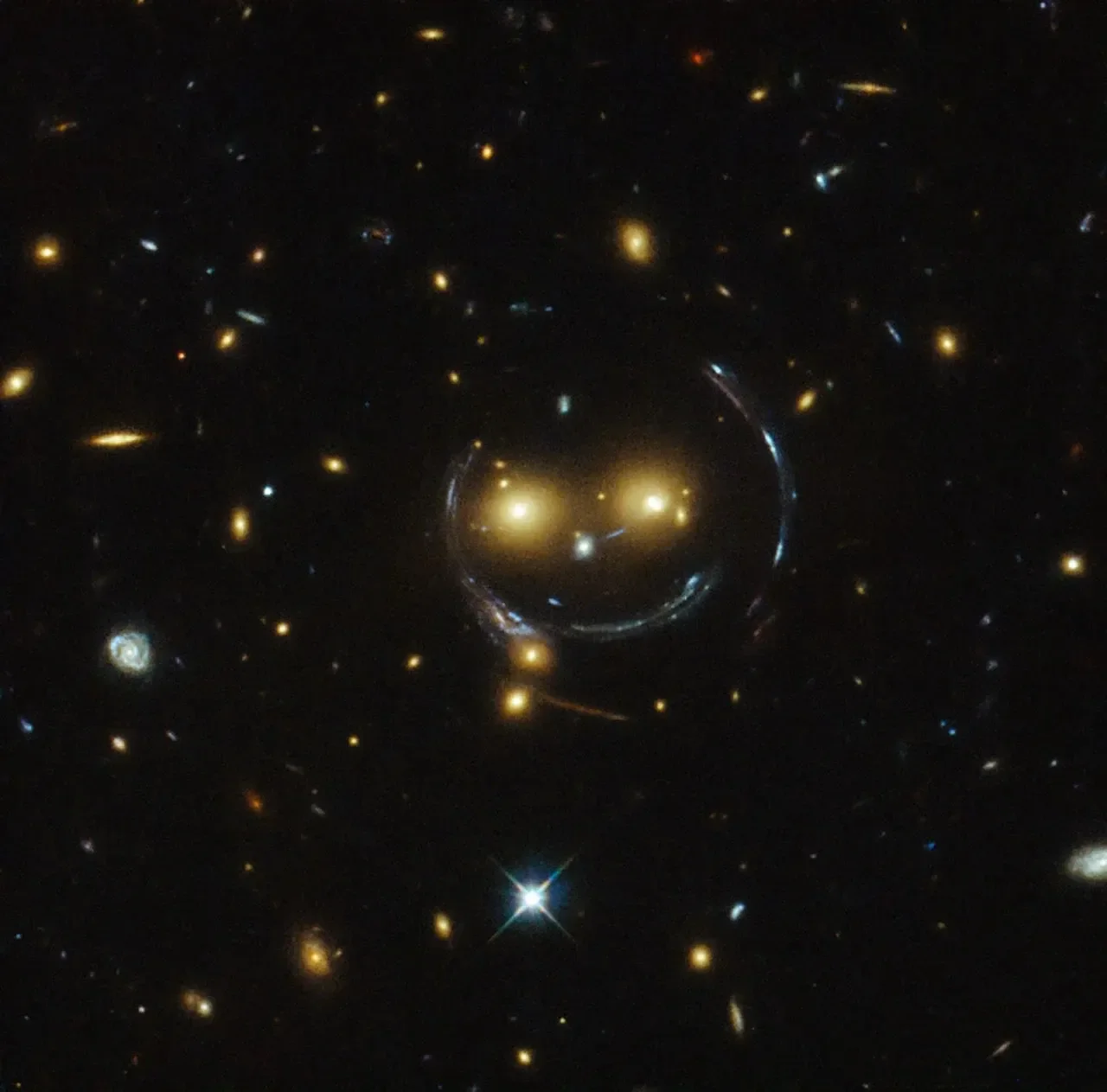
I’ve noticed a lot of talk about microlensing and gravitational lensing lately, so when one of my paid subscribers asked me about it, I knew it was time for an article!
Lenses and Refraction
Most of us are familiar with lenses in our daily lives. We might wear glasses or contact lenses to help us see better, or we might have used a microscope, telescope, or magnifying glass to see things up close or far away. But how do these lenses work? To put it simply, a lens curves or bends light. This curving of light is called refraction. Light refracts when it passes through something that has an amount of transparency. We can easily see this when we put a straw into a cup of water. The straw looks like it is bent or disconnected at the line between the air and water.
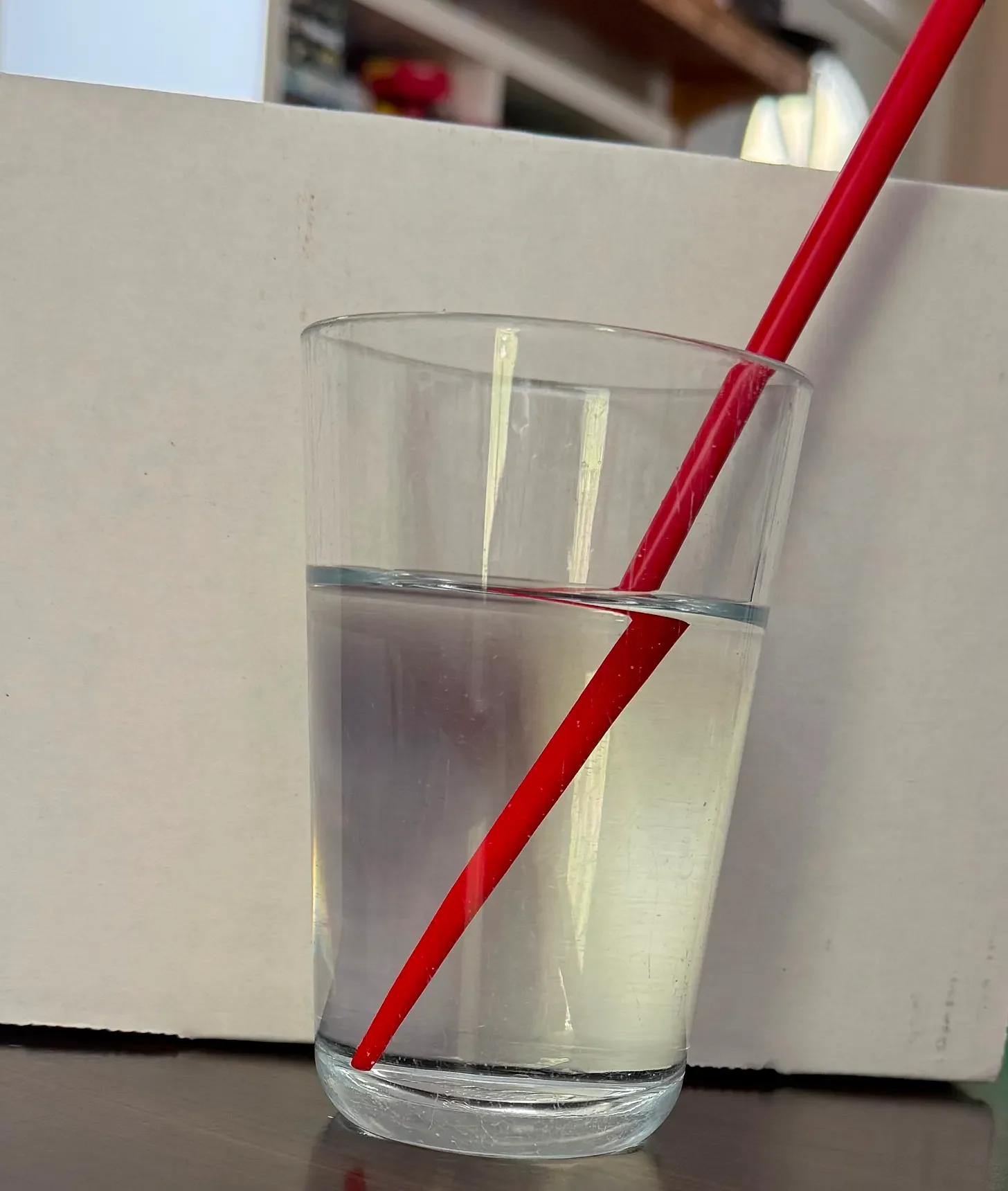
I used a chopstick in a glass of water. See the disconnect?
The same thing will happen if you shine a beam of light into the water. The water acts like a lens, bending/refracting the light because the water is denser than the air is. It slows the photons of light down, making it seem to shift positions. The lens can even change the shape of the light as well. In the picture below, I shone a light through a glass of water, and it changed the point of light coming from the pointer into an oblong shape. Different lenses will distort the light in different ways depending on how they are curved and how thick they are. We can use lenses on purpose in order to focus light in ways so we can see better, through glasses and other things.
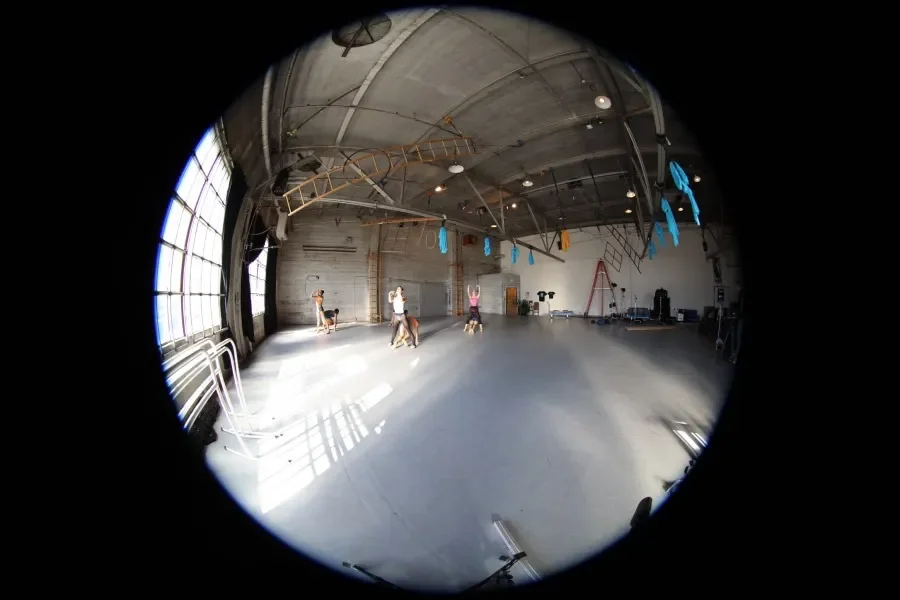
An example of a lens distorting an image. See how bent things are?
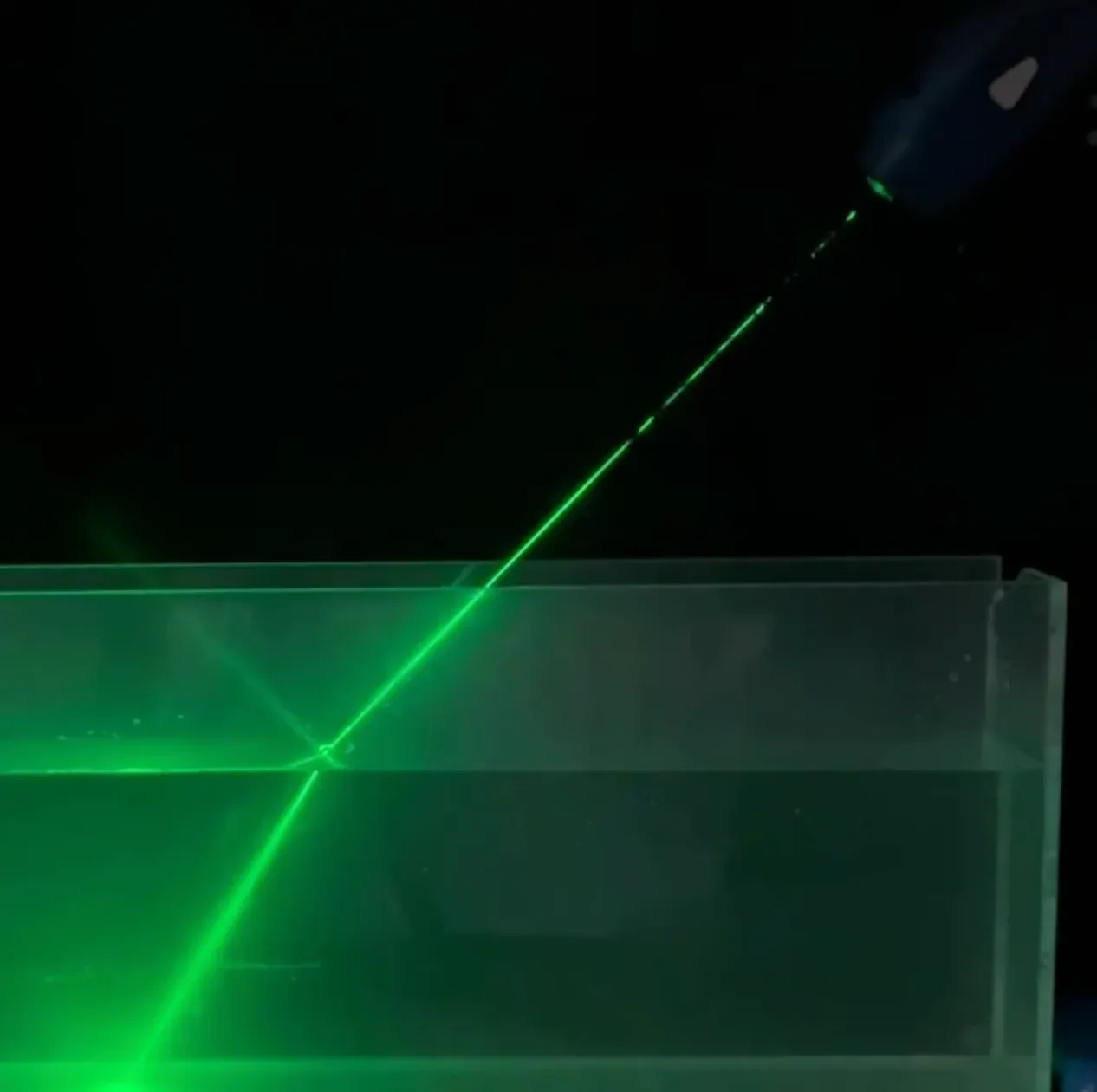
You can see how the light bends downward when it hits the water. Image: Simon Poliakoff. Watch his video for a demonstration.
So, a lens is something that bends and focuses light, distorting our view of it. Lensing can happen naturally or we can do it intentionally. Things like glass, plastic, water, and air can act as lenses. But did you know that gravity can also be a lens?
Gravitational Lensing
When Albert Einstein developed his theory of general relativity, he predicted gravity as a curvature of what he called “spacetime,” the combination of space and time. Since photons are particles of light, he thought they should follow the curve created by gravity just as other matter should. The path the light takes as it interacts with gravity is bent and distorted, creating a lens effect caused by the body whose mass is creating the gravity.
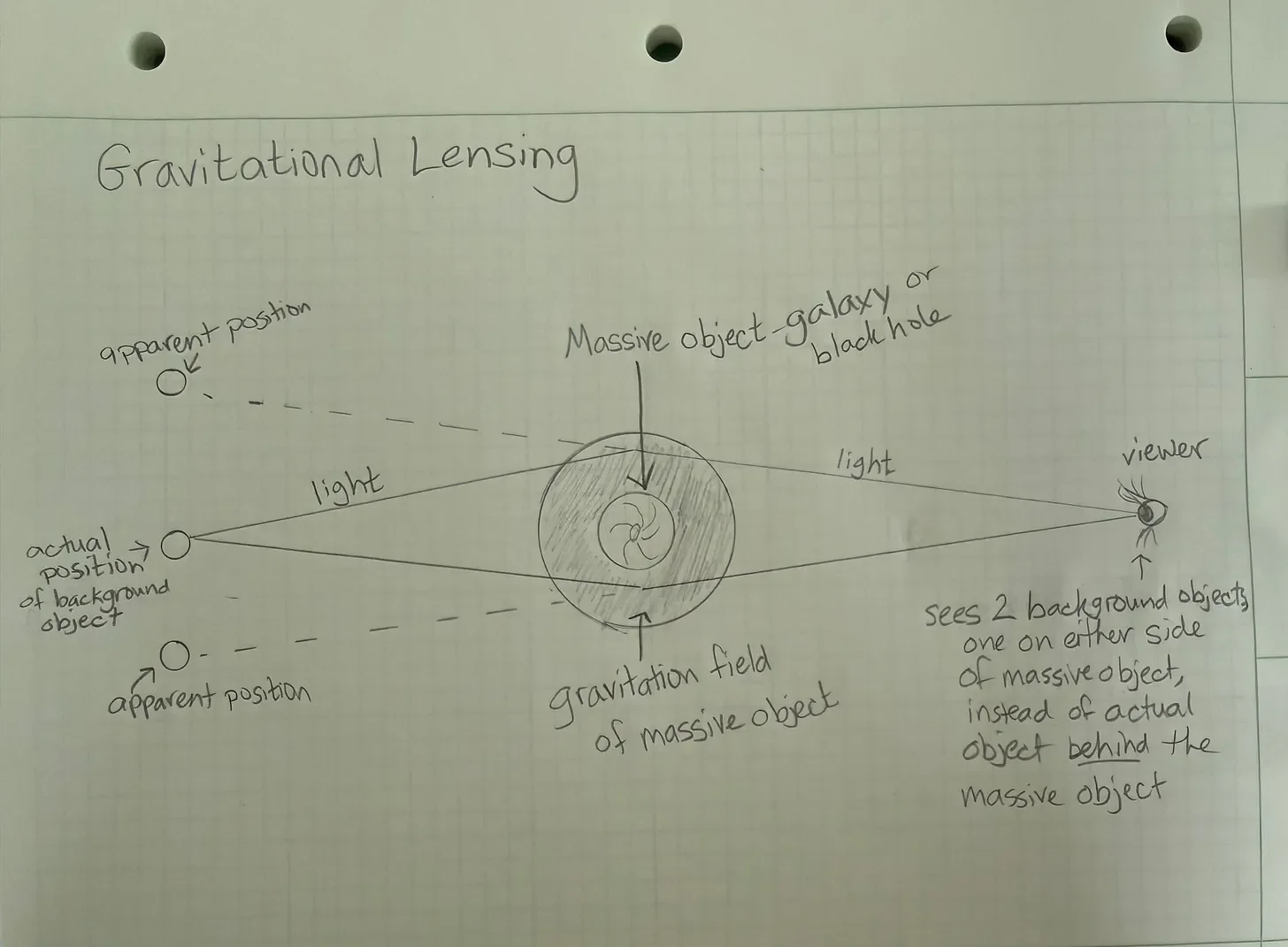
Graphic by Melanie Meadors
Einstein’s prediction, called gravitational lensing has been proven true by several experiments over the past century. With the launch of the Hubble Space Telescope, scientists have been able to use the concept of gravitational lensing, as this bending of light due to gravity is called, to study black holes and galaxies, things with huge amounts of mass that bend light around them. When a massive body like a black hole is in front of something that is emitting light, like a star, the pull of its gravity will bend and distort the light of the star behind it, making the star seem curved as well as shifting the image of the star so it looks like it’s actually to the side of the massive object, rather than behind. The more massive an object is, the more it distorts light, sometimes creating the illusion of four stars rather than one, or even a circle of light rather than a star. All of this is because of gravity bending light.
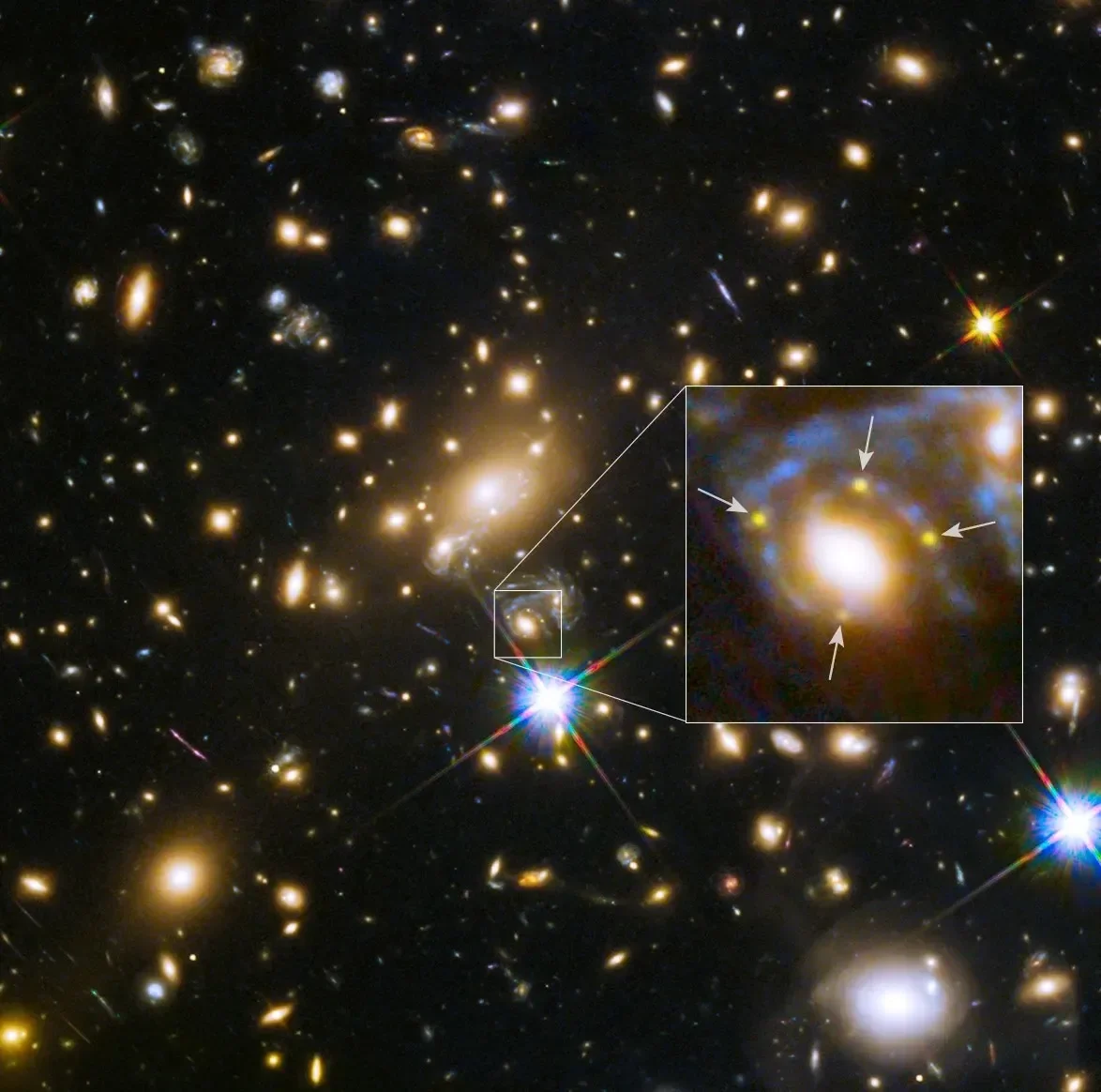
The four dots around this galaxy are actually one supernova that is behind the galaxy in front of it. The light from the supernova is being bent by the galaxy’s gravity. Image: NASA/ESA/STScI/UCLA
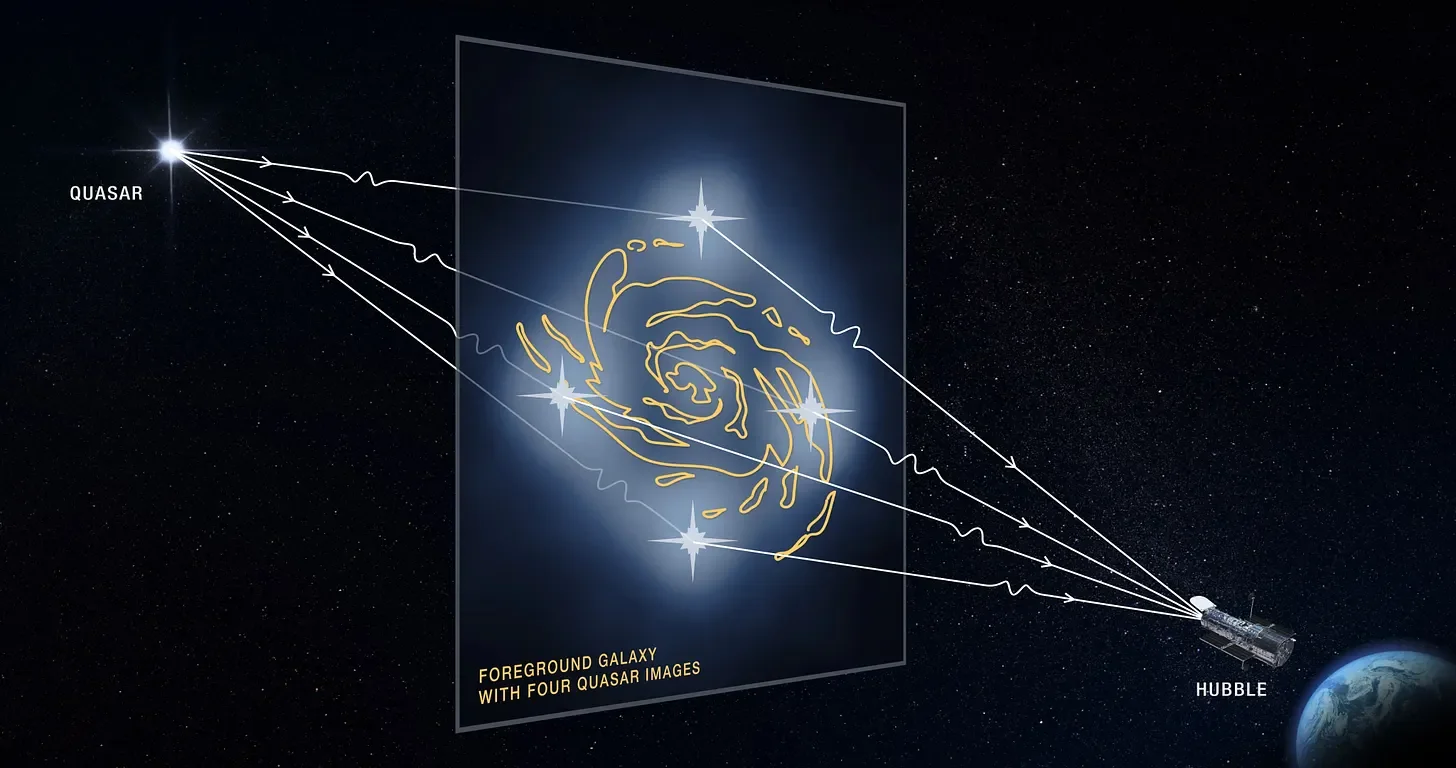
Diagram of a situation like the above photo. NASA, ESA, and D. Player (STScI)
This effect, however, isn’t only present with ultra-massive objects. Smaller objects have a similar effect, which scientists are finding to be very useful. This effect is called gravitational microlensing.
Gravitational Microlensing
Astronomers using the Hubble Space Telescope were able to measure the amount a white dwarf—a dying star that was once like our sun—bent the light of a background star in order to determine the mass of that white dwarf. This white dwarf was only half the mass of our sun, yet it distorted the light of the background star enough to be measured and scientists were able to determine the amount of the white dwarf’s gravity. Since gravity and mass are proportional (the more mass, the more gravity), and we know the mathematical formula to make the calculation, that means scientists were able to figure out the mass of the white dwarf using this indirect method. This type of study can help astronomers learn more about the life cycles of stars like our sun. But microlensing can be used for even more exciting things.
A video showing how a planet can be detected. See how the false images of the star behind the lens star and planet (middle) both brighten, and then the bottom one brightens again as the planet passes in front of it?
Microlensing can help us see things that we can’t detect other ways. Astronomers have learned how to discover exoplanets that are normally far too small to see or detect in other ways using this method. If a star can create a lens effect on something behind it, then so can a planet. When a system with a star and a planet crosses in front of a background star, the star will create the expected lens effect, but then so will the planet, albeit on a much smaller scale. The lens effect will increase as the star passes in front, then decrease, then it will increase again a little bit as the planet passes, and then it will decrease again. So even though the planet might be too small to detect visually, we can know of its existence because of this microlensing effect. The Hubble Space Telescope has been great for helping scientists make these discoveries, but soon there will be a new addition to the space telescope family that will specifically be using gravitational microlensing to find exoplanets and more.
The Nancy Grace Roman Space Telescope
You might have heard the news that construction has just been completed on NASA’s newest space telescope. Set to launch by May 2027 (NASA says they are aiming for a September 2026 launch), the Nancy Grace Roman Space Telescope has been outfitted with special equipment that will allow it to use microlensing to discover exoplanets as well as brown dwarf stars (dark stars that have burned through all their fuel which are very hard to detect) and rogue planets that are not affiliated with a star system. As these smaller, dark objects pass in front of stars, they will create a lens effect, alerting us to their presence.
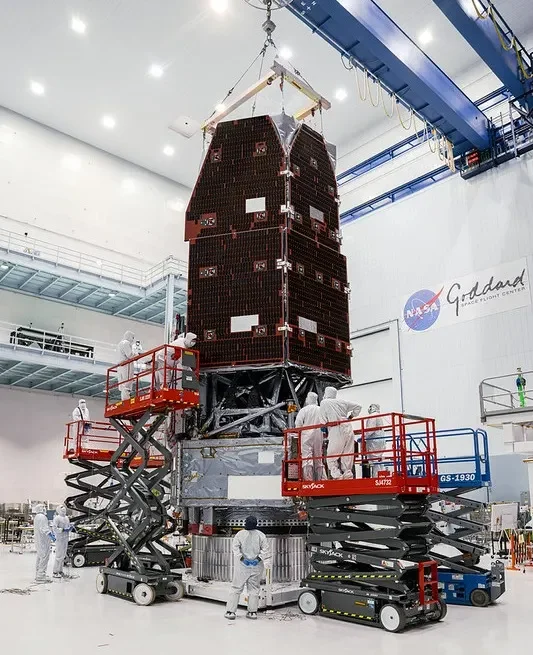
Image: NASA/Sydney Rohde
Because microlensing is useful to detect dark objects, scientists also hope the new Roman telescope can help them learn more about other dark stuff in the universe, namely dark matter, stuff in the universe that has mass but that we haven’t been able to observe or measure directly. Roman will look for “clumps” of dark matter by looking at the warping of light from distant galaxies. Scientists want to learn how common these clumps of dark matter are. This will help us tell the story of the early universe and how galaxies first formed. If the clumps formed quickly and are prevalent, that means dark matter consists of heavier particles that settled into the formation of galaxies early in the history of the universe. If these clumps are not common, then that suggests dark matter is lighter and faster, taking longer to settle and clump and form structures like galaxies. Remember, we don’t know exactly what dark matter is, or even if it exists as we think at all, so anything we can learn like this will be useful.
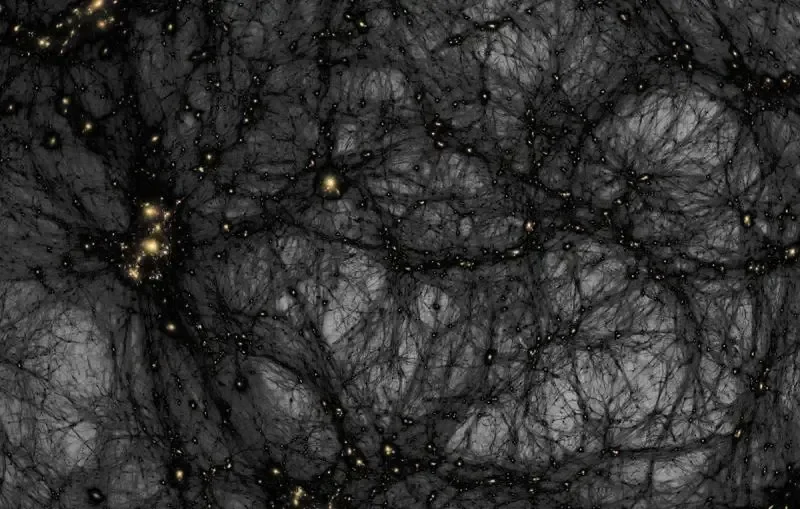
Simulation of what dark matter clumps and webs might look like. Image: Ralf Kaehler/SLAC National Accelerator Laboratory, American Museum of Natural History
Microlensing is a valuable part of our cosmological toolbox, and with the help of the Nancy Grace Roman Space Telescope, we could finally put together more pieces of the puzzle that is the origin of our universe and the role dark matter played in it.