Citizen Science: Protecting Our Skies
Many people wonder how they, as ordinary citizens, can help the astronomical community. After all, what could a regular Joe possibly do to help people who have giant telescopes and PhDs? Well, one way you can is through NOIRLab’s Globe at Night program.
The amount of skyglow around the Earth has increased exponentially over the past century because of growing populations and the increasing modernization of developing countries. The night sky looks very different. In places where we could once see the Milky Way streaming across the sky, only a few hundred stars at most can pierce the glow caused by man-made lights. There are people out there who have forgotten what the night sky looked like when they were kids. (You can learn more about the problem of light pollution in my previous article here.)
If you are enjoying this article, please consider subscribing to Space for the Rest of Us! Free subscribers get a weekly article, and paid subscribers get sneak peeks at my book projects, video content, behind the scenes looks at my research, and more!
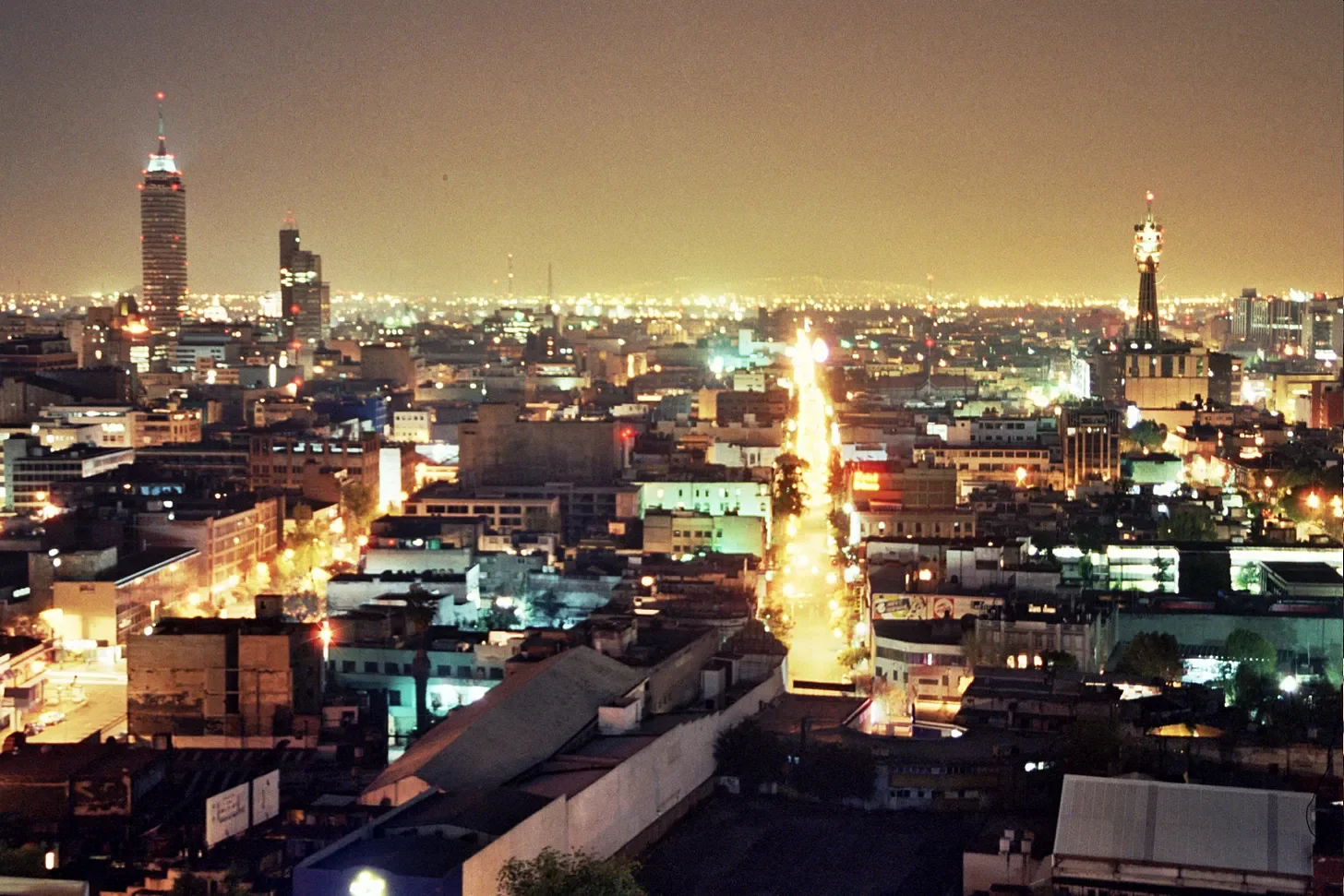
Mexico City night sky. It is not dark at all!
About fifteen years ago, many people started replacing their incandescent lights with LEDs in an effort to save on electricity costs, have longer lasting bulbs, and increase visibility. Whole cities have replaced streetlights and other outdoor lighting with LEDs. Researchers were torn about the impact of these lights on light pollution. Some were optimistic. The U.S. Department of Energy predicted the impact of LED lights would be overall positive. Many others, however, saw more problems than benefits. LEDs give more light for a given amount of power. This means that people can decrease the amount of power they are using to get the same brightness. If you are accustomed to a 60 Watt incandescent bulb, you would need a lower wattage LED bulb to get the same amount of light (measured in lumens). A great many people, however, are not decreasing the wattage of bulbs they are using—they are just making things brighter. Because LED lights are cheaper to use, people are also more likely to use them for longer stretches of time than they might have used their old system of lighting.
Having an accurate measure of how much light pollution better arms policy makers to introduce measures to combat light pollution. In the past, scientists used satellites to map the amounts of sky glow present around the world. These measurements used to be fairly accurate. There is a problem today, however, introduced by LED lights. While both incandescent and LED bulbs produce light that appears more or less white, incandescent bulbs make light that is a bit more on the red end of the visible spectrum of light, and LEDs make like that is more blue. This means incandescent bulb light has a longer wavelength, and LED light has a shorter wavelength. Our atmosphere scatters shorter wavelength light more easily than long wavelength. So more red light gets through the atmosphere to the satellites that are taking measurements, and less blue light reaches them, no matter how much is produced on Earth, because it’s scattered. This light returns to Earth as skyglow. Satellites can’t pick up wavelengths shorter than about 500 nanometers. LED lights fall into the 400-500 nm range.
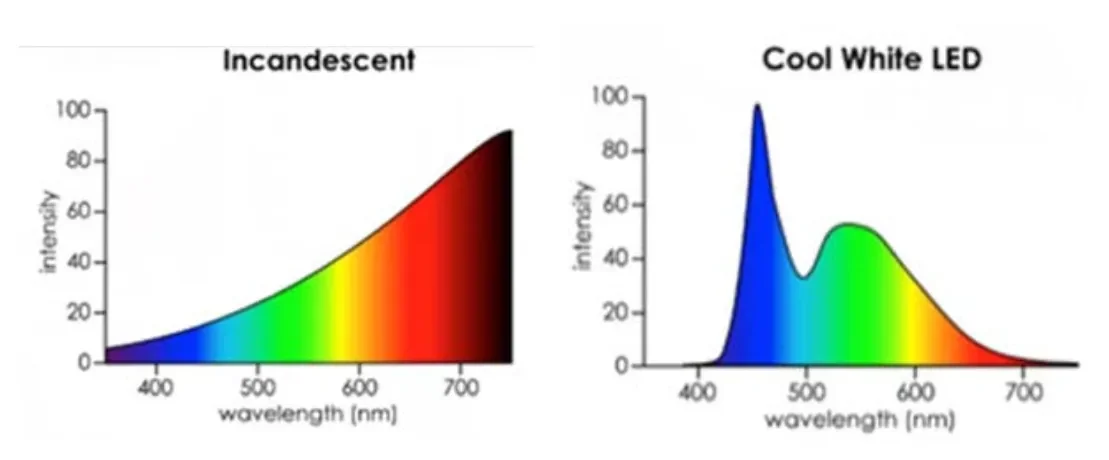
Comparison of light bulbs. Incandescent light wavelengths peak in the red zone. Cool white LED wavelengths peak in the blue zone—you can see that the wave for incandescent is longer than the wave for LED, and the LED is much brighter in the blue, whereas the incandescent is brightest in the red.
What does this mean? Well, it means that the satellite readings are no longer as accurate of a measure of light pollution as they used to be. We can’t rely on this information any more, because it doesn’t reflect what we are experiencing on the ground. And this is where YOU come in!
In the NOIRLab Globe at Night program, citizen scientists—people just like you, all over the world, who don’t have careers as scientists but still want to be involved—get a set of star maps that correspond with the hemisphere they are in (the northern hemisphere sees different stars than the southern hemisphere does, because of where we are on the globe—we can’t see the stars on the other side of the planet because Earth blocks the view!). These people take these star maps out and choose the ones that match the sky as it appears to them. Some people might only see the very brightest stars from their locations. Some people might be able to see more than that, and others might not be able to see any stars at all. A lucky bunch might see much more, maybe even the Milky Way, if they live in a very rural area with no light pollution. The number of stars people can see on a clear night is a direct correlation to how much light pollution in in the sky.
This program started in 2011. By 2022, they had received over 51,000 submissions from all over the world. In 2022, NOIRLabs scientists took all the data they received over that ten-year period and put it all together in a report. They found out that over the course of ten years, light pollution increased on average about 10% per year. At that rate, it means that children lose a big part of their night sky as they grow up.
“At this rate of change, a child born in a location were 250 stars were visible would be able to see only around 100 by the time they turned 18,” said Christopher Kyba, a researcher at the German Research Centre for Geosciences.
Kyba and his team, including an astronomer from NOIRLab Connie Walker, took the data and compared it to the satellite data from the same time period to see how much the use of LED lights affected the data. Their predictions were accurate, as far as how much of the short wavelength LED light the satellites could pick up. While the ground-based science recordings showed a definite increase in light pollution (9.6% per year), the satellites reported an overall increase of just 2%, and even showed a decrease in some years, because so much of the light was never reaching the satellite sensors because of atmospheric scattering! The citizen science project, therefore, isn’t just some cute busy work to keep people feeling like they are doing something. The data they report is absolutely necessary to get accurate readings of light pollution and skyglow! This is a HUGE step in helping policy-makers to introduce measures that will make a difference. We can take steps to fix the problem when we know how bad the problem is to begin with.
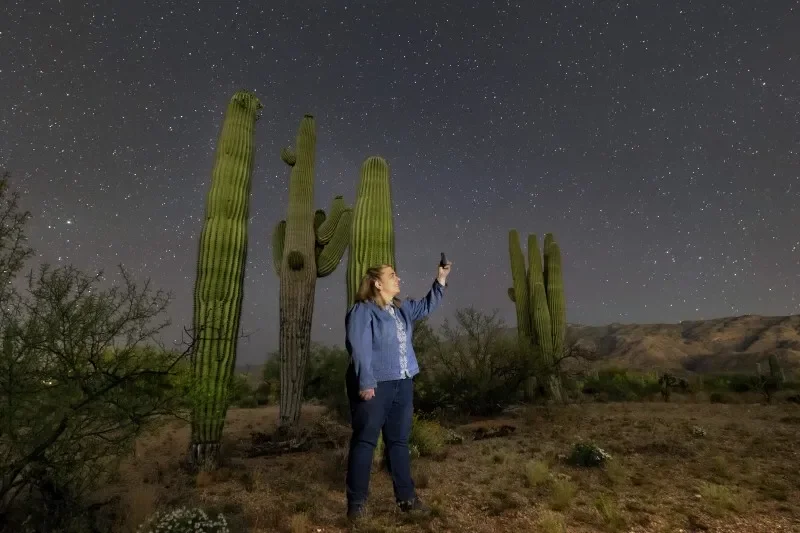
NOIRLab’s Connie Walker collecting data for Globe at Night from Tucson, AZ. Credit: NOIRLab/NSF/AURA/R. Sparks & P. Marenfeld
Every month, the Globe at Night website opens up for submissions for a 10-day period around the time of the new moon, when the sky is the darkest. You can follow the instructions on the “report” page and submit data for your location. It’s fast, it’s easy—and it’s important!
“The increase in skyglow over the past decade underscores the importance of redoubling our efforts and developing new strategies to protect dark skies,” Connie Walker, an astronomer at NOIRLab and the developer of the Globe at Night project, said. “The Globe at Night dataset is indispensable in our ongoing evaluation of changes in skyglow, and we encourage everyone who can to get involved to help protect the starry sky.”
This project shows that together, we really can make a difference!
May we all have darker night skies in the future,