The Boötes Void: Not Quite as Dramatic as Social Media Proclaims (but still cool!)
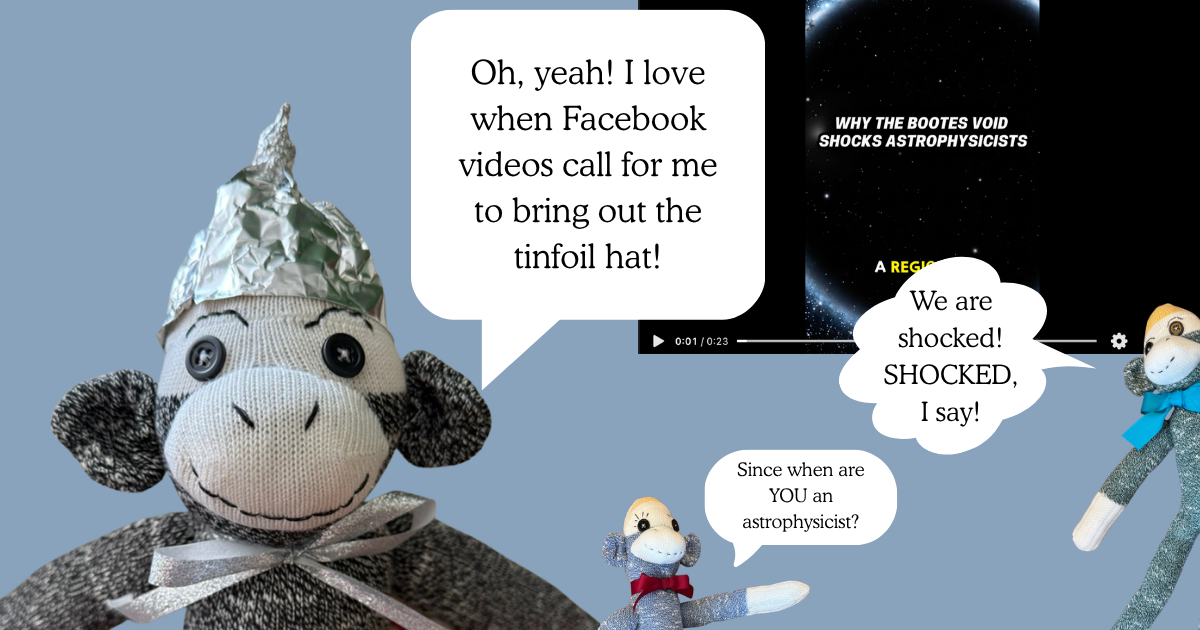
I'm sure, if you are at all interested in astronomy and are on social media, you have seen some of the ludicrous posts from pages claiming to be about astronomy. Everything in these posts is overly dramatic, and they are always accompanied by fake images ("The closest view of Uranus EVER!"). I used to try to call them out, but with so many of them now that have people commenting that seem to be quasi tinfoil hat fanatics who want to believe the world is going to end and who will not listen to anything factual, I know I will just be wasting my time. Instead, I decided to release articles discussing the truth behind the AI-written drama. For my first, I'm going to talk about the Boötes Void, what it is, and what it is not.
In our universe, there are clusters of galaxies. We belong to some: the Local Group, as well as the the bigger cluster the Local Group belongs to called the Virgo Supercluster. One thing we've learned about the universe is that it isn't homogenous--it's not the same everywhere. There are lumps and bumps, clusters, and...well, voids. The larger scale that we look at, the more "clumpy" things appear. The most recent models of the universe suggest that on a "mega-scale," the universe looks like a web, with strings and clumps and "empty" space between. I put empty in quotes because we don't really know for sure what is out there, and these voids behave in a way that suggests there might be something to them. But I'll get back to that later--and I promise it's not as dramatic or scary as the social media posts claim ("SCIENTISTS HAVE NO IDEA WHY!!")
Remember how I said our galaxy belongs to a group or cluster of galaxies called the Local Group? Well, there is a Local Void as well, which begins at the edge of our cluster. The Local Group of galaxies is about 10 million light years across and contains 30 galaxies, including the Milky Way, Andromeda, and the Triangulum Galaxy. The Local Void, on the other hand, is 150 million light years across. The galaxies of the Local Group are traveling through space toward each other at around 175 miles per second and away from the Local Void because of gravity. The more mass an area has, the more gravitational pull it has, so that makes sense.
Now, the Local Void isn't completely empty. We know with certainty of one dwarf galaxy in it called ESO 461-36, a very small, very dim galaxy that is headed across the void toward our group at 135 miles per second. Scientists believe there may be others out there like this little guy, but we haven't been able to confirm anything for sure. There are also several galaxies that are right on the edge of the void that scientists are studying to see if they should be counted as coming from the void or if they originated with our group.
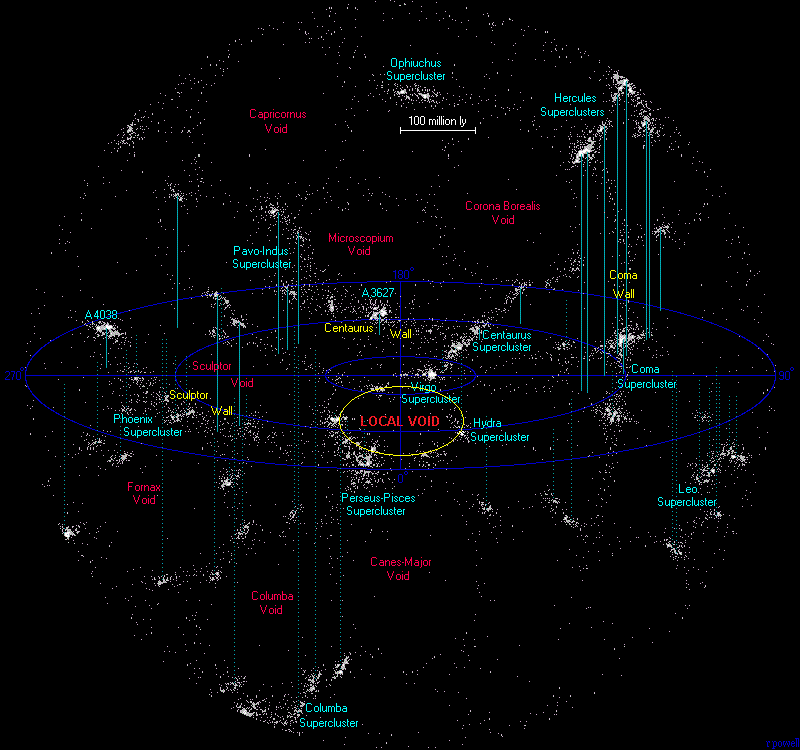
Scientists found that just as matter attracts other matter with gravity and clumps together, empty space seems to "come together" as well in these voids, meaning the voids get larger and larger, possibly by connecting with other voids. This can potentially be explained by the matter outside the voids rushing away from the void toward areas of more mass by the force of gravity, leaving spaces in the filament shape that galaxies tend to collect in. As the galaxies move toward other galaxies, they leave space, which in turn come together to connect the spaces of the two voids on either side of them, combining the voids into one larger one, kind of like when soap bubbles come together.
The Local Void is obviously not the only void out there in the universe, otherwise we wouldn't feel the need to call it local. There are lots of them, including the one that spurred me to write this article, the Boötes Void. While the Local Void, which is in the constellation Hercules in the night sky (you can't really see it with what you have at home) was discovered in 1987, the Boötes Void (in the constellation of the same name) was discovered earlier, in 1981. It is at least twice the size of the Local Void, at over 300 million light years across. In a comparable space, we would expect to see about 2,000 galaxies. But in the Boötes Void, there are only 60 known galaxies. It is one of the largest voids in the known universe, and has also been referred to as a "supervoid."
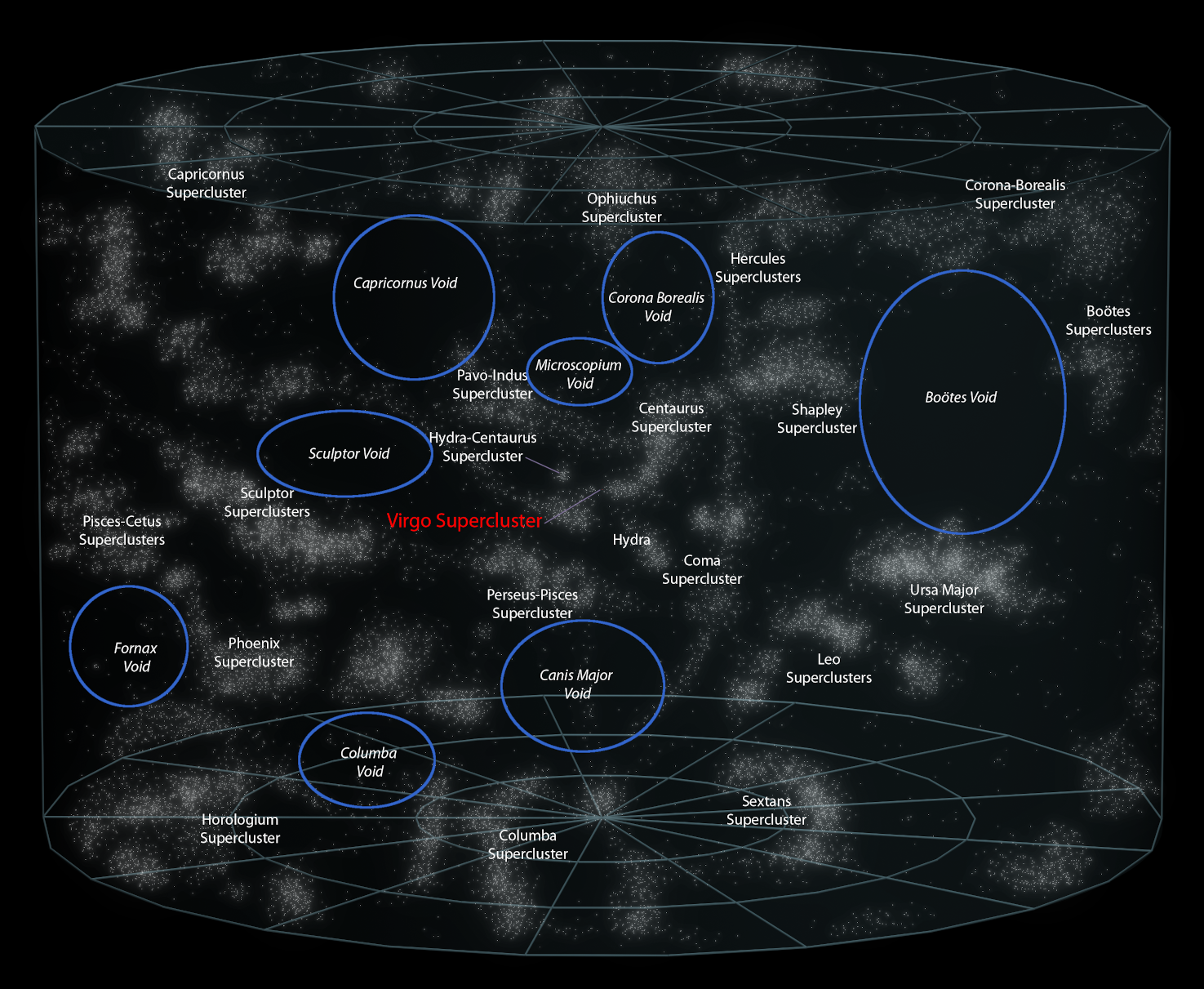
While many of the social media posts present the information about the Boötes Void as scary or dramatic, as if it's some sort of villain in a horror movie, in actuality, the more we learn about it and the other voids, the more we can understand the structure of the universe. The more we understand the structure of the universe, the more we can understand how it--and we--came to be.
Yes, Monkeys, even you.
There are a lot of guesses as to what might explain the behaviors of voids, or these space bubbles. Maybe it has to do with dark matter, or anti-matter. Maybe, like the smallest bits of matter we know of, things on the largest scale of the universe are mostly empty space as well. But there is nothing scary or shocking about these voids. Rather, scientists are excited to learn more about them!
The July issue of the Looking Up! zine is complete and ready to be printed! If you want to get YOUR physical copy in the mail, be sure to sign up as a $5 or above member by July 15th! All proceeds go directly into my public astronomy programs.