Reading Like a Writer: Emma Southon's 'Agrippina'
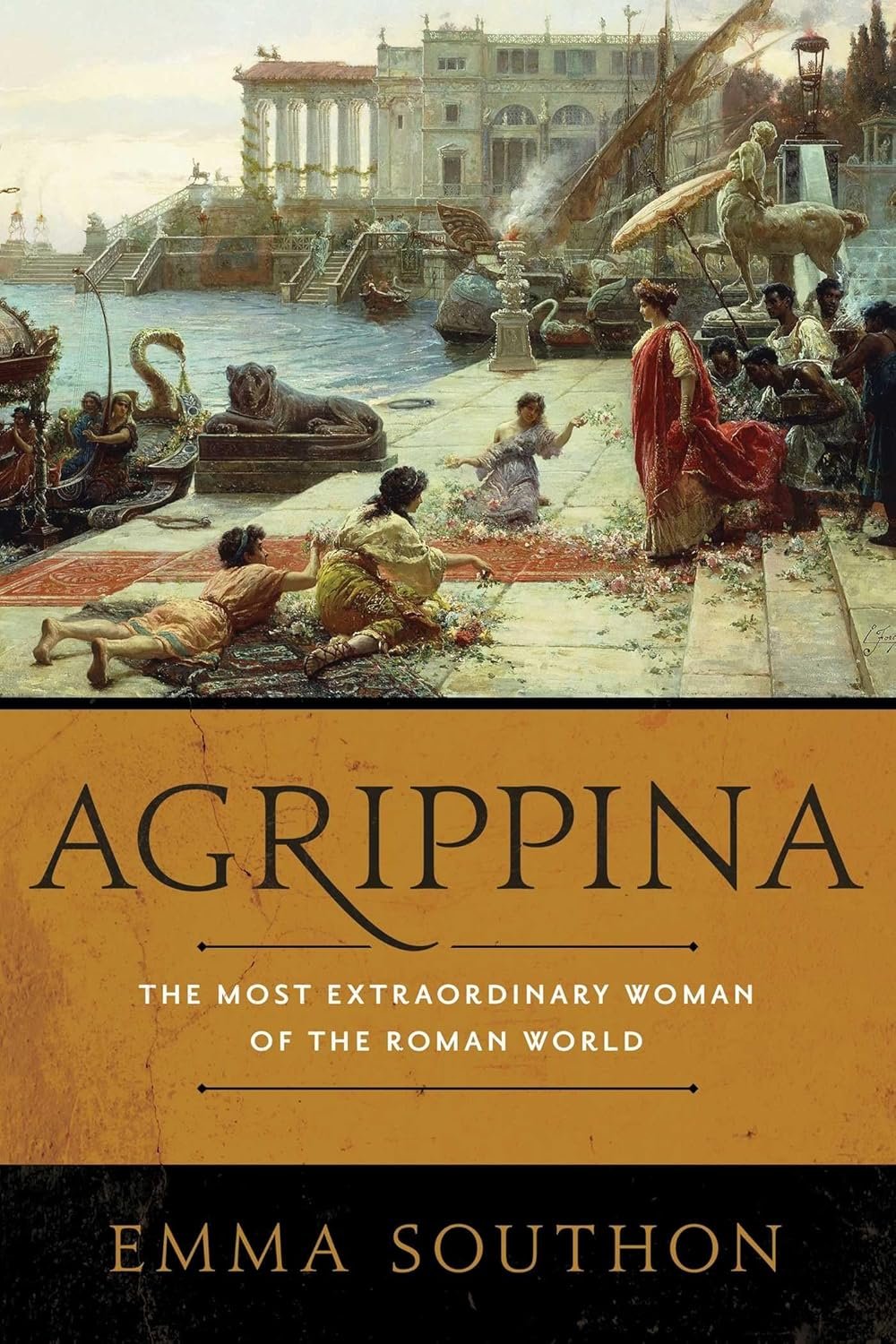
As someone who is writing the biography of an ancient Roman woman, of course I am devouring as many other people's works on the subject as I can in order to see how they handled their prose, their research, and how they filled in the many blanks that exist. Most recently, I read Emma Southon's biography of Agrippina (Agrippina: The Most Extraordinary Woman of the Roman World, Pegasus, 2019), and holy cow is it a master class in so many ways. Southon is a historian of ancient Rome who got her PhD in the subject from the University of Birmingham, and reading her book is a fascinating look not only at the life of an amazing woman, but also at how one can take ancient history and make it palatable and even fun for popular audiences.
For those unacquainted with Agrippina, she was the great-granddaughter of Augustus, the granddaughter of Tiberius, the daughter of Germanicus, the sister of Gaius (Caligula), the wife of Claudius, and the mother of Nero. She was tangled in a giant knot in the Julio-Claudian "clusterfuck," as Southon puts it, and was considered the most powerful woman in the world (however one can measure power in a world that didn't value women very much beyond their ability to bear sons). There are three sources of information about Agrippina from the ancient world: Tacitus's Annals, Suetonius's Twelve Caesars, and Cassius Dio's Roman History, all of which have various degrees of incompleteness. Couple this with the sources' biases and their focus on men, what they covered and what they did not, and any biographer would have their work cut out for them. Emma Southon, however, not only took on the task, but she created a work that is as entertaining as it is informative. She accomplished this in several ways.
First, Southon refuses to take the ancient sources at face value. She goes not only between the lines of these sources, but against the grain of their biases to find the real Agrippina. She recognizes the significance of Agrippina's appearances and silences in the sources. According to Southon, "Women don't exist in political narratives unless they are telling us something about the men they represent." She is not sycophantic about the sources. Instead, she turns the narratives on their heads and calls out the misogynistic elephant in the room. She draws attention to the fact that the male-centric sources mention Agrippina when she is disrupting the story of the men and when she is invading the male sphere. When Agrippina is "behaving herself" and doing as an imperial daughter, wife, and mother should, the sources are silent. "It is only when she is overstepping the invisible boundaries of female behavior that she gets noticed," Southon says. Acknowledging this allows Southon to tease out details from the male-centered history and create a more female-centric narrative. The men's stories in this book serve Agrippina's story, not the other way around. Southon deliberately and openly pushes the men to the sidelines when they aren't serving the narrative.
Secondly, Southon talks to her readers throughout the book, centering them as her audience. Reading this book is like having a conversation, listening to someone relate a crazy story over beers in the pub. She is the polar opposite of your stuffy classics professor from the 1990s (or, at least, mine). She makes the ancient Romans into three dimensional, real people and has fun while doing it. Yes, there is swearing. Southon plays the part of your most crude, vulgar, and fun aunt in this adventure through ancient history discovering a fascinating woman. I laughed out loud several times, and bothered my partner more than once reading lines to him. This direct engagement with the reader keeps them hooked, and Southon's strong voice carries them through the book from start to finish.
Southon helps situate her readers with an introduction that deals with truth in the sources, and how to sift facts from fiction, how to identify sensationalism, and how to figure out what to believe. She gives a brief overview of Roman history up to the point where her story begins, so the reader has context. At the back of the book, she provides a family tree, a timeline, a "dramatis personae," and a glossary to guide readers. She recognizes in the text where things get confusing (every daughter with the same name as the mother, for instance), and prevents the cross-eyed reader from feeling stupid by not only explaining things thoroughly but acknowledging that a lot of this is, indeed, stupid.
Finally, Southon makes her subject relatable to audiences today by using analogies with pop culture:
"Basically, Germanicus was the Beatles."
"But they were family, and--like Michael Bluth--the Julio-Claudians always put family first."
"Across the empire, Agrippina the Elder and Germanicus were basically the Prince William and Kate Middleton of their day."
and, one of my favorites, about Claudius's uncontrollable giggles, "And if we're honest, if any of the minor British royals--Prince Andrew, maybe--started guffawing uncontrollably at the embarrassment of a fat person during a public performance, we'd probably not take it too well either. Imagine the Guardian headlines."
Emma Southon proves herself to be clever enough to use these jokes and analogies where effective, and to step back when they aren't necessary. I found this to be a powerful tool to keep readers engaged, but in the wrong hands, it could be overused and become jarring and annoying rather than amusing. Southon seems to work it in just the right way, not completely distracting from the subject at hand.
Writing a good, engaging book takes more than just facts and figures. An author who knows a subject and can make it their own through style and voice will grab a reader's attention and hold it through hundreds of pages. Emma Southon proves herself to be that sort of author with Agrippina.
Did you enjoy this post and want to see more? Subscribe to have my articles delivered to your inbox! Want to support my work as an independent researcher? You can make a one-time contribution to my Ko-fi, or you can sign up to be a Patreon member. You can also buy a blank book or journal from my bindery shop! Every little bit helps me with my mission to make ancient history accessible to everyone!