Gladiator Glasses: Collect the Whole Set!
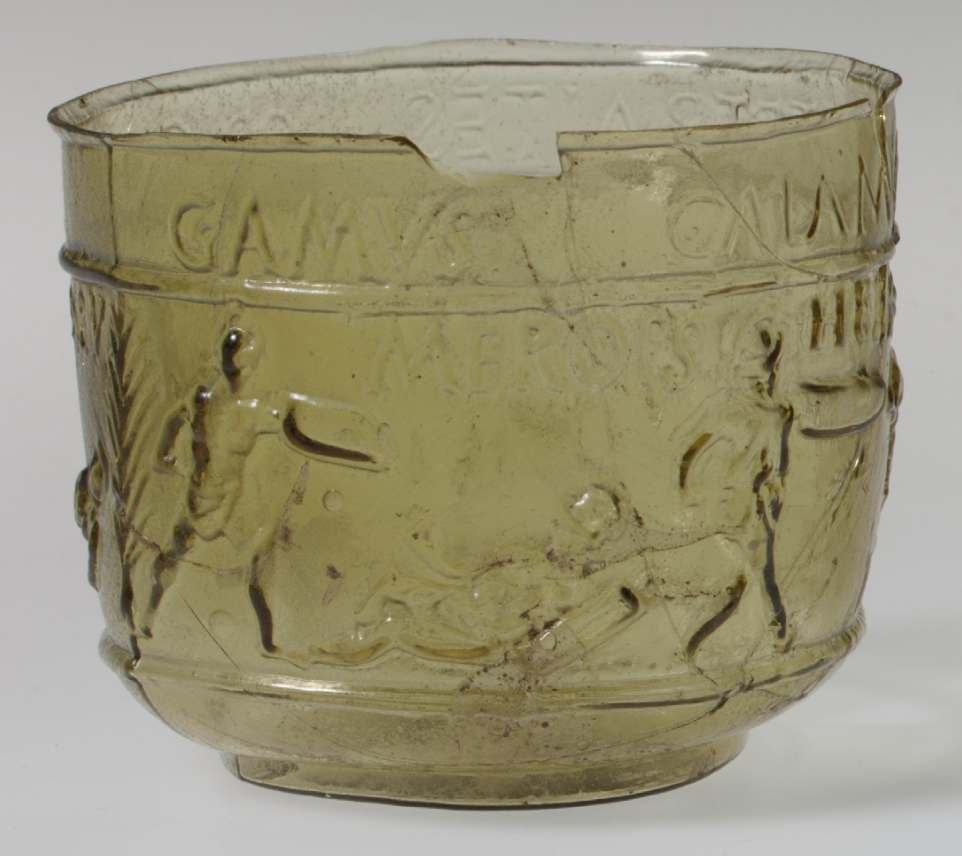
Montagnole cup, Metropolitan Museum of Art, public domain
If you've ever been to a modern-day professional sporting event, chances are you've come home with one of of those huge plastic cups printed with the home team's logo that comes with an over-sized sugary drink. Or, if you didn't feel like spending upwards of $20 for a soda, you've seen one. We've definitely all seen glasses and mugs at local department and discount stores with football and baseball teams printed on them (that invariably come off after a few washes in the dishwasher). But would it surprise you to learn that these cups were not entirely a modern invention? Archaeologists have discovered glasses at ancient Roman sites dating from around the first century C.E. that serve the same purpose: they commemorate favorite gladiators and charioteers.
Like many people today, ancient Rome loved their spectator sports, particularly chariot racing and gladiatorial matches. And also like today, one could find every echelon of society at these games, from the poor to royalty--in the case of Rome, even the emperor himself. Suetonius reported that Gaius Caesar Augustus Germanicus (you might know him better as Caligula, but that's just rude) was a huge fan of the Green faction of charioteers, and gave one driver two million sesterces in sponsorship. Yes, while corporations sponsor teams today, individual people did in ancient Rome. That's an article for another day. But people in ancient Rome collected glasses that commemorated their favorite drivers and fighters.
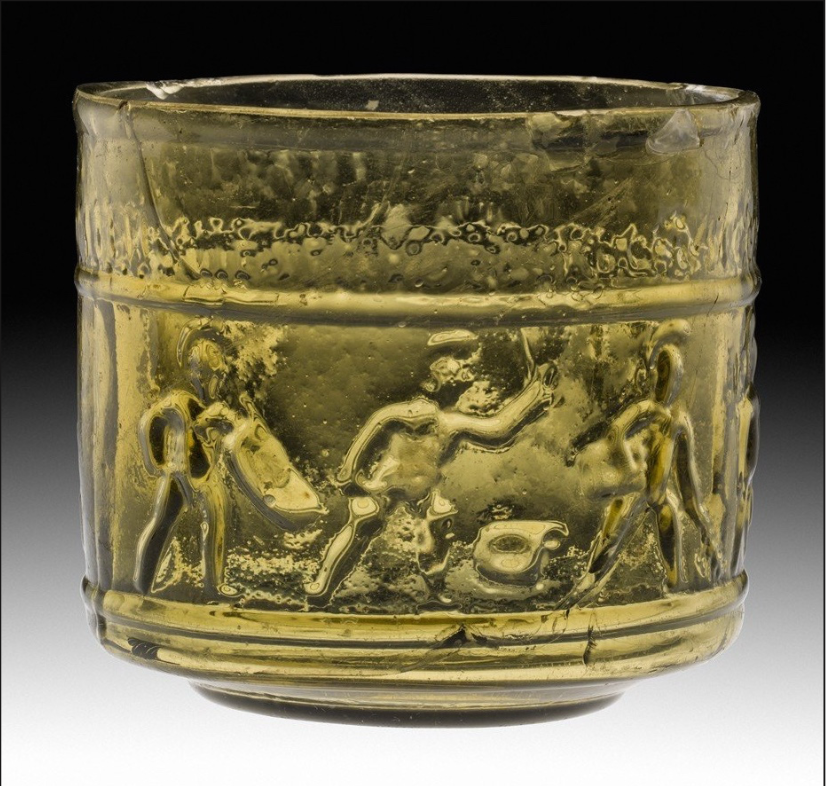
The Chavagnes Cup, Corning Museum of Glass (fair use)
These souvenir glasses looked very similar to our drinking glasses today. They were translucent and could be various colors from amber to green to blue. Rather than being printed like most sports glasses today, these Roman glasses had images formed in the glass itself by way of a method called mold-blowing. An artist would make a mold out of clay with the relief of the design he wanted, and then would blow a globe of molten glass into the mold to take its shape. Archaeologists believe the molds used to make the "spectacle cups" were in three parts, two side and a bottom. Once the glass was blown. the mold was taken apart and the cup would get some finishing touches before it was left to cool. While most of these sports glasses found featured gladiators and charioteers, there have been a few with boxers and wrestlers. Unfortunately, we haven't found any of the original molds used in this process.
The glasses are fascinating not only because they exist in the first place, but because they tell us specific things. Not only do they show images of fighting and racing, but they give us specific names of people taking part in the sports. They give names to people who might otherwise be lost to time, and they confirm the names of others who have been mentioned in written records.
On the glasses that feature gladiators, the men are shown holding shields and are in different positions. We can tell who is winning or losing by whether they are standing, lying prone, or holding a hand up for reprieve, and we can tell the men's fighting styles by the shape of the shields they bear, either long and rectangular (scuta) or square (parmulae). The names of the gladiators circle the glass above the fighters. Gamus, Merops, Calamus, Columbus, Tetraites, Spiculus, and more are listed. By cross-referencing these names with existing writings, we can even learn more about these men. For example, thanks to Suetonius, we know that the aforementioned Emperor Gaius ordered poison to be rubbed into the woulds of Columbus because the emperor favored his opponent. Proculus, another name on the glass, started out as a spectator at the games, but he was ordered by Gaius to go fight in the arena. Gaius presumably expected him to lose against the professional fighters, but instead, he surprised everyone by emerging victorious. His laurels were short lived, however. Not one to appreciate surprise or embarrassment, Emperor Gaius had him executed. Suetonius isn't the only one to help us learn more about these fighters, however. There is graffiti in Rome, Pompeii, and other places, rough images scratched into walls, that depict gladiators with the same names as those on these cups.
Cross-referencing the mentions of fighters' names has taught us more than just facts about their lives. It has also shown us that these pairs of fighters could not have fought in the same matches as other pairs on the same cups. Some lived during Gaius's reign (37-41 C.E.), and others during Nero's (54-68 C.E.). This shows that these cups were made to celebrate legendary matches together rather than single events.
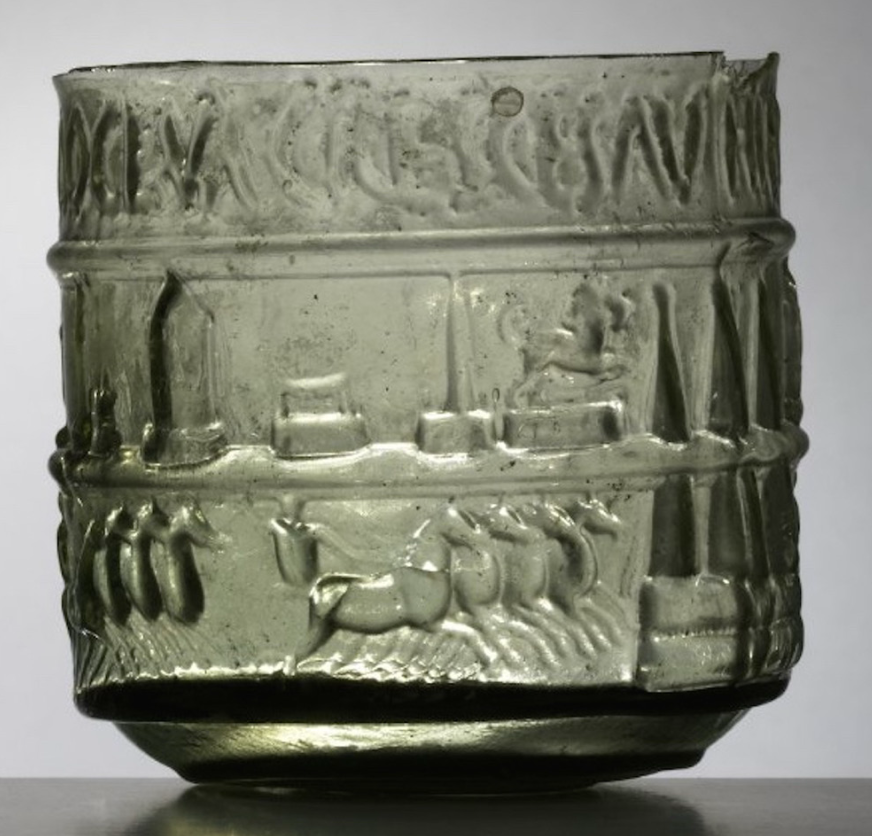
Colchester Cup, British Museum, Creative Commons 4.0
The glasses that show chariot races add an additional aspect that enhances our experience of the ancient Roman sport. The show chariots racing around the track/cup, and like their gladiator counterparts, they name the drivers. Eutychus, Muscolus, Crescens, and more are commemorated. In addition to the names, however, other words that seem like cheers appear on the cups, so they say things like, "Hail!" and "Go!" and "So-and-So wins!" This lends a sense of excitement to the events on the cups and perhaps echoes things that were shouted in the stands at the arena.
These cups have been found at dig sites not only in Rome itself, but in the farther provinces of the empire as well. Some have been found in burial sites, suggesting that they were valued possessions. It's hard to say whether these glasses would have been bought at stalls right at the arena as souvenirs of a trip there, or if they were bought and sold elsewhere. But these glasses tell us that people in ancient Rome thought about their sports in much the same way we do today. They provide a unique connection between ancient times almost two thousand years ago and today.
You can read Suetonius's accounts of Emperors Gaius (Caligula) and Nero, including mentions of chariot racing and gladiators at Tufts University's Perseus project. You can also watch a demonstration by the Corning Museum of Glass of ancient Roman mold-blown glass techniques on the museum's YouTube channel. If you want to see some of these glasses for yourself, you can visit the Corning Museum of Glass, the Metropolitan Museum of Art, the British Museum in London, as well as other museums.
Did you enjoy this post and want to see more? Subscribe to have my articles delivered to your inbox! Want to support my work as an independent researcher? You can make a one-time contribution to my Ko-fi, or you can sign up to be a Patreon member. You can also buy a blank book or journal from my bindery shop! Every little bit helps me with my mission to make ancient history accessible to everyone!